

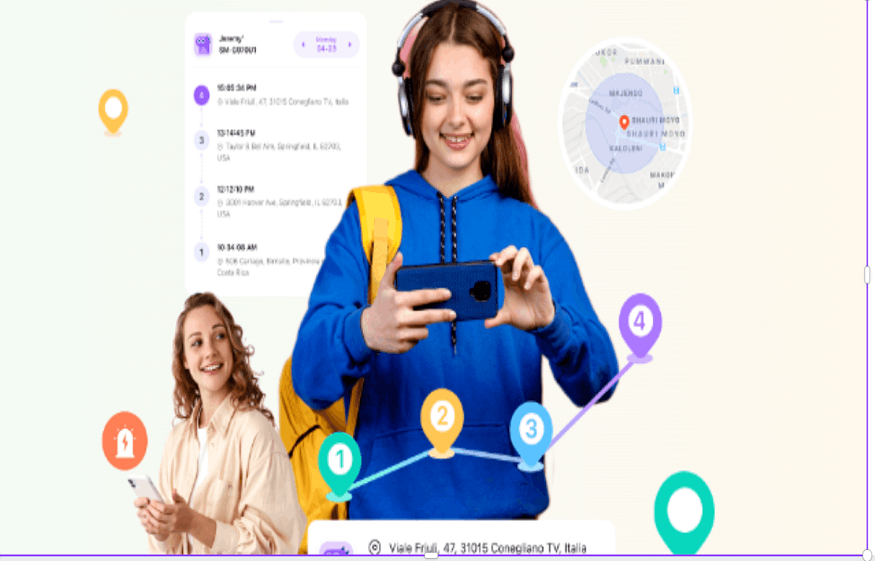
It usually starts with a moment of worry. A child is not answering. A phone has gone missing. An unknown number keeps calling. Someone searches for a way to find a phone’s location from its number, and the results fill up with sites offering exactly that.
The pages look professional. There are maps, satellite images, countdown timers, and reassuring words like “secure,” “instant,” and “100% accurate.” Some even have reviews and trust badges. It is easy to believe they work.
Most of them do not, at least not in the way they claim. And some can cost families money, privacy, or both. This article explains what a typical phone number tracker website really does, the warning signs to watch for, and safer ways to handle the situations that send people looking for one.
What these sites promise
Most phone number tracker sites make a similar pitch:
- Enter any phone number and see where the phone is right now
- No app needed on the other phone
- The person will never know
- Works on any network, anywhere in the world
- Results in seconds
Read More : What Is a Virtual Warehouse in Snowflake?
Each of these claims should raise questions. A phone’s live location is protected information. It sits with the phone itself, the mobile carrier, and apps the owner has given permission to. It is not available to anyone who types a number into a website.
In 2024, the US Federal Communications Commission fined major carriers nearly $200 million for selling customers’ location data through third parties without proper consent. If carriers can be penalized that heavily for sharing location data, it is very unlikely that an anonymous website has legitimate access to it.
What these sites actually do
Behind the polished pages, most of these services rely on a few simple tactics.
The fake search
You type in a number. A progress bar fills. Messages appear: “Connecting to network,” “Triangulating signal,” “Location found.” Then a payment screen appears before you can see the result.
Those messages are not connected to any real search. They are designed to make you feel close to an answer, so you are more willing to pay.
The link request
Some services do something real, but not what they advertise. They send a text message to the number you entered, often disguised as a delivery update, a prize, or a friendly message. If the person taps the link and their browser asks to share location, and they tap allow, the site can see roughly where they are.
That is not tracking by number. It depends entirely on the other person tapping the link and agreeing. It also means a stranger’s message, sent in your name or the site’s, has landed on someone’s phone. If that person is your teen, it is a good illustration of why children should never tap links from unknown senders.
The area code guess
Some sites show the general area where a number was originally registered, based on its area code or the carrier. That might tell you the number is from a certain state or region. It does not show where the phone is today.
The subscription trap
Many sites ask for a very small trial payment, sometimes less than a dollar. Buried in the terms is a much larger subscription that starts automatically, often within days. Consumer reviews for these kinds of services frequently describe surprise charges and difficulty canceling.
The US Federal Trade Commission’s guidance on free trials and auto-renewals advises consumers to read the terms before signing up, know when a trial ends, and check bank and card statements for charges they did not expect.
Warning signs to watch for
Before entering a number, or a card, on any location website, look for these red flags:
- Promises of secret tracking. Any site that says the person “will never know” is either not telling the truth or offering something unethical and often illegal.
- No clear company details. No real business name, address, or contact information.
- Countdown timers and pressure. “Offer ends in 4:59” is a sales tactic, not a feature.
- Tiny trial prices. Very low upfront fees often hide much larger recurring charges.
- Vague results before payment. Blurred maps or partial addresses designed to make you pay to see the rest.
- Requests to send a link to the other phone. This is not tracking by number. It relies on tricking someone into sharing.
If you see two or more of these, close the page. It is also worth searching for the site’s name along with words like “refund” or “subscription” before entering any details. Other people’s experiences are often the quickest warning you will get.
The privacy risk to you
Using one of these sites can also put your own information at risk. You may be handing over:
- The phone number you entered, which could be a family member’s
- Your own email address and phone number
- Your payment card details
- Your browsing and device information
There is often no clear way to know where that information goes or how it is used. For families, the safest choice is simply not to use these services.
For a closer look at how these claims work and why they fall short, this article on how phonenumber location claims work walks through the methods in more detail.
Better options for common situations
Most people search for a phone number tracker because of a real problem. Here are better ways to handle the most common ones.
“My child’s phone is lost.”
Use Google’s Find Hub, signed in with the child’s Google account. It is designed to locate, ring, lock, or erase a lost Android device.
“I can’t reach my child and I’m worried.”
Call their friends or the place they were going. If you already share location as a family, check the app. If you believe they are in danger, contact local emergency services.
“I want to know where my teen is when they go out.”
Agree on location sharing openly, such as Google location sharing for the evening or a family app your teen knows about. Use time limits where possible.
“An unknown number keeps calling.”
Block it, report it as spam through your phone, and do not call back or tap any links it sends.
“Someone may have my child’s number and I’m worried they could find them.”
A phone number alone does not reveal live location. Focus on the real risks: links, shared live locations, app permissions, and public posts. Talk with your child about not tapping unknown links and not sharing location with people they do not know well.
Talk with your children about these sites
Teens sometimes come across these sites too, out of curiosity or because a friend mentioned them. They may also receive the link messages these sites send.
A short, calm conversation helps:
- Explain that most “track any number” sites do not work as claimed
- Explain that tapping a link from an unknown number can share location if you allow it
- Agree that if they receive a strange link, they will not tap it and will show you instead
- Remind them that secretly tracking someone is not okay, whether it is a parent, friend, or partner
That last point matters. Teens should understand that consent is part of healthy relationships, including when it comes to location.
Why parents are a target
Many of these sites aim their marketing directly at parents. The adverts show worried mothers and fathers, missed calls, and children out late. Some claim to be “parental control” tools while offering nothing a parent could not get for free from Google’s own services.
That targeting works because parental worry is real and urgent.
A parent who cannot reach a child at 11pm is not in the mood to read terms and conditions. Knowing this ahead of time helps. If you ever feel that rush of panic and find yourself on one of these pages, take it as a sign to step back, call the people your child was with, and use the tools you already have.
It also helps to set up legitimate tools in advance, so you are never tempted. Find Hub on every family phone, location sharing agreed with your teen, and a written plan for when someone cannot be reached will do far more than any phone number tracker ever could.
If you have already paid
If you have already signed up for a phone number tracker site and are worried about charges:
- Look for the cancellation option in your account or the site’s terms, and cancel as soon as possible
- Keep screenshots of the sign-up page, the terms, and any emails
- Check your bank or card statements for any recurring charges
- Contact your bank or card provider if you see charges you did not agree to, or if you cannot cancel
- Consider changing any password you reused on the site
The FTC’s guidance includes steps for stopping subscriptions you did not mean to start.
The bottom line
Phone number tracker websites sell a simple promise that rarely matches reality. Live location is not available to the public from a number alone. What these sites usually offer instead is a fake search, a link that relies on someone tapping it, a rough area guess, or a subscription that is hard to escape.
Read More : What Is a Virtual Warehouse in Snowflake?
For families, the better path is clear: use tools built for the job, set them up openly, and talk with your children about the real ways location can slip out. That approach costs nothing, protects everyone’s privacy, and actually works.